
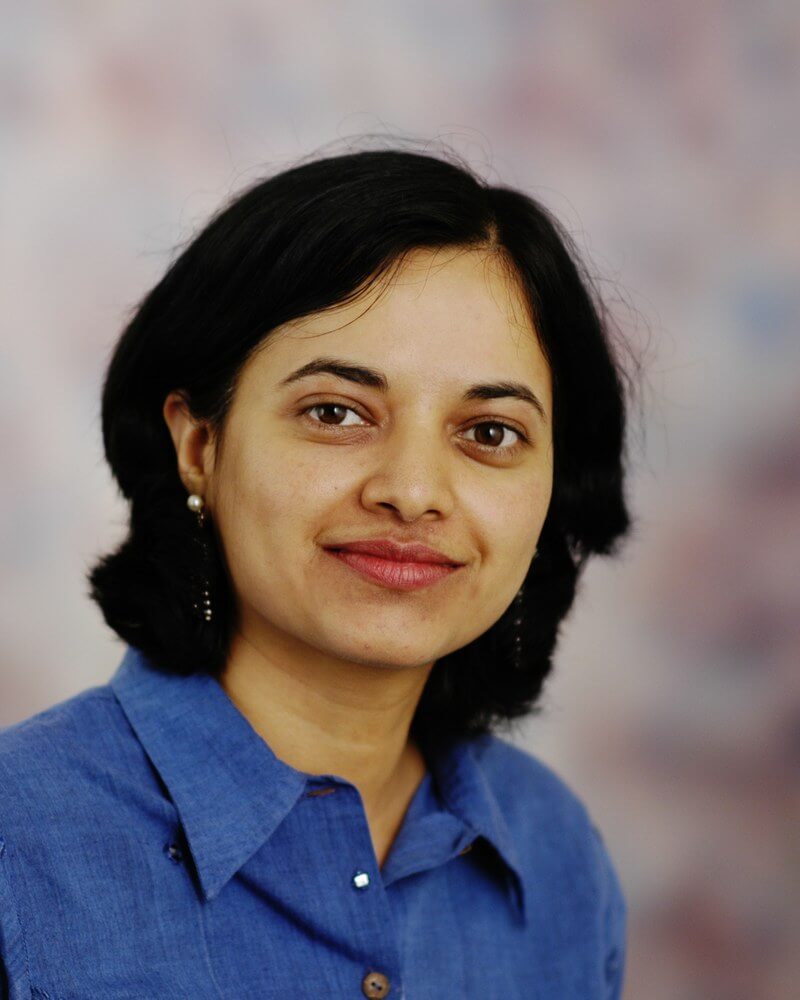
Interview by Irene Mussio and Dennie Van Dolder — May 2026
Lata Gangadharan is Professor of Economics and holder of the Joe Isaac Chair at Monash University. Her research uses experimental and behavioural methods to study cooperation in social and environmental dilemmas, compliance, gender and social identity, with work published in journals including Science, PNAS and the American Economic Review. She is a Fellow of the Academy of the Social Sciences in Australia and President of the Economic Science Association.
How did you end up in behavioural or experimental economics?
I wasn’t fully aware of this field when I began graduate school. My initial interests were in environmental economics and questions about cooperation, externalities, and the role of markets. Then I took a course in Experimental Economics and was immediately drawn in. Traditional models often felt too limited to capture the richness of human behaviour— especially in areas like public goods, norms, and environmental or social dilemmas. Experimental methods offered a clean, causal way to uncover the mechanisms driving these behaviours. Once I began running experiments, I was hooked by the combination of methodological rigor and the creativity the field demands.
What question or problem currently motivates your research the most, and why?
My research currently centres on two main themes. The first is inspired by social and environmental dilemmas, where I examine mechanisms that promote cooperation within and across groups and the roles played by guilt, normative principles, and redistribution. The second theme focuses on norms, institutions, and the behavioural drivers of inequality, particularly gender inequality. Many economic outcomes are shaped not only by incentives but also by social expectations, confidence, and evaluation practices. My work investigates how these behavioural and institutional factors interact, and how we can design environments— whether in workplaces, communities, or markets—where individuals can thrive regardless of their identity or background.
What do you see as the most important developments or challenges for behavioural and experimental economics over the next 5–10 years?
A key development in the field is large-scale experiments which now allows researchers to study behaviour in settings with higher external validity. A related emerging challenge is the influence of AI on data quality, particularly as many researchers rely on online platforms for participant recruitment and experimental execution. Understanding and addressing how AI-generated responses or AI-mediated behaviour may distort data will be increasingly important for the discipline. In this context, laboratory experiments under controlled conditions can play a crucial benchmarking role, helping researchers compare behaviour observed online with behaviour in more tightly controlled environments.
How has your research evolved over time?
My research began with a focus on environmental markets, social preferences, cooperation, and competition, often using laboratory experiments. Over time, I expanded this work to examine topics related to corruption, gender, leadership, performance evaluation, and institutional design. I now conduct laboratory, online, and field experiments and also collaborate with scholars across disciplines. My research, in general, aims to generate behavioural insights, with a particular focus on how norms and institutions can be strengthened to promote fairness and efficiency.
What are the biggest challenges you’ve faced in your research?
An important challenge has been to design experiments that capture the complexity of real-world decision-making while maintaining strong internal validity. We are also increasingly expected to translate our findings into meaningful policy recommendations—by journals, grant agencies, and policymakers. This can take time, as policy-relevant insights often emerge only after multiple related projects accumulate enough evidence to clarify what is both effective and scalable.
What advice would you give to PhD students or early-career researchers entering the
field today?
Choose research questions that matter to you—curiosity and a sense of purpose will sustain you through setbacks. Build strong methodological foundations in experimental design, theory, and empirical methods, and don’t hesitate to draw on insights from other disciplines when they strengthen your research. Learn how to design clean identification strategies. Build collaborations, both vertical (with more senior scholars) and horizontal (with your peers). Apply for grants periodically; even unsuccessful applications can be valuable because they force you to clarify your ideas, articulate why your work matters, and refine your research agenda. And finally, patience and humility will serve you well throughout an academic career.
If you could redirect £10m of research funding tomorrow, what area would you direct it to?
What a luxury that would be! I would invest in a large-scale research program examining the behavioural drivers of inequality—particularly how identity and social norms operate within rapidly evolving institutional and technological environments. A substantial portion would support building experimental infrastructure across countries and sectors, enabling researchers to track how preferences, beliefs, norms, and behaviours evolve over time. Such longitudinal, cross-context data would be useful for designing policies that meaningfully improve
cooperation, reduce inequality, and strengthen institutions. The program would also actively support and involve many junior scholars, helping develop the next generation of researchers in the field.