
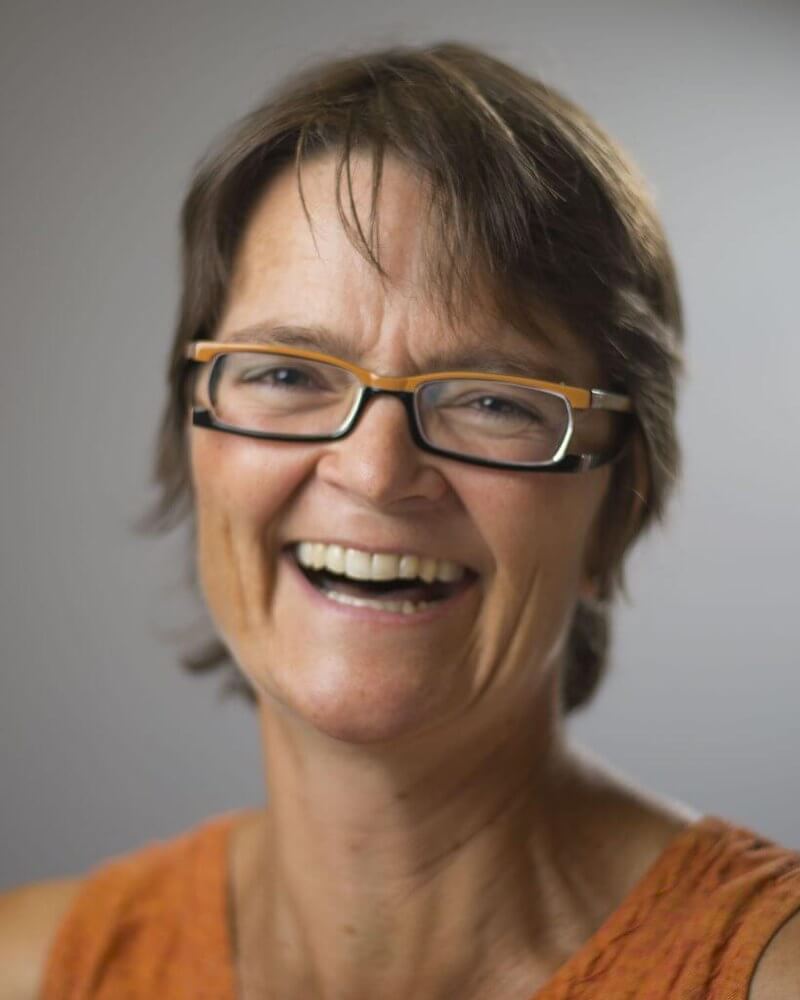
Interview by Irene Mussio and Dennie Van Dolder — May 2026
Brit Grosskopf is Professor of Economics at the University of Exeter Business School and a member of the BEE UK Advisory Board. Her research sits at the intersection of economics and psychology, using experiments to study social preferences, reasoning, learning, reputation and identity. She completed her PhD under Rosemarie Nagel in Barcelona and subsequently worked with Nobel laureate Al Roth at Harvard, before establishing the Birmingham Experimental Economics Laboratory (BEEL). She is currently Deputy Chair of the Economics and Econometrics panel for REF 2029.
How did you end up in behavioural or experimental economics?
I was first exposed to experiments in a game theory course delivered by Werner Gueth, who had moved to Humboldt University where I was an undergraduate student at the time. I wrote my undergraduate thesis on theoretical asymmetric auctions though and moved to the Universitat Pompeu Fabra with the thought to specialise in contract design and IO. While there I met Rosemarie Nagel and took her experimental econ class which got me finally hooked.
What question or problem currently motivates your research the most, and why?
I think there are mainly two areas now. One relates to emotions and how they affect our decision making. The other is behaviour towards those that a decision maker perceives to be different from themselves (e.g. differences based on gender, age, ethnicity, educational background etc).
What do you see as the most important developments or challenges for behavioural and experimental economics over the next 5–10 years?
Let’s start with the challenges. I think one of the biggest one is to teach our next generation of experimentalists (and those that might just sometimes complement their research with experiments) to properly conduct experiments. It has become relatively cheap to run online experiments. I have seen quite a few cases where researchers think they can quickly churn out some data and only later think about contrasting alternatives. I am not against online experiments (and have conducted them myself). They have provided a lifeline during Covid and are a great tool especially if one wants to reach a certain demographic or get a representative sample. However, great care should be taken in ensuring subjects pay attention and responses truly come from well incentivised human decision makers. The other challenge is funding. Researchers at well-endowed universities with access to larger research funds can conduct studies with dozens of treatments and many more subjects than others who are limited in their funds. The funding landscape in the UK has become increasingly competitive and limiting.
As for the important developments, well, AI is certainly something to watch, from the use of synthetic cultural agents to how our minds change with access to AI and what it means for our decision making. We also need to move beyond blaming individuals for systematic failures/nudging them to make “better” decisions to building more inclusive societies with an active role for policy and governments basically redesigning institutions so that mistakes don’t compound.
How has your research evolved over time?
I started out with only lab experiments and have over time ventured into both online as well as field experiments. I am in the process of embarking on my first RCT.
What are the biggest challenges you’ve faced in your research?
Funding always seems to be a limiting factor. Early on I was advised not to waste my time on questions like happiness and emotions. Once I got tenure, I felt I could wander a bit more from the mainstream. I once also was told not to bring my still nursing daughter into a talk as a male presenter found the “suckling” noise disturbing. Now that she is older, balancing travel as a single mum remains an issue. Luckily, most institutions/conferences have been supportive of me bringing my daughter along, but her school doesn’t appreciate my research travels with her as much.
What advice would you give to PhD students or early-career researchers entering the field today?
Be curious, never stop asking questions and read older papers yourselves instead of just asking AI to summarize them. Pay attention to detail and recognise the beauty of simple designs.
If you could redirect £10m of research funding tomorrow, what area would you direct them to?
I wish! 😊
Personally, I would support culturally diverse investigations that are not just focused on one country or subject pool. Gender norms across the continents and discrimination against those that are not necessarily mainstream need to be investigated more and more consistently, ideally with interdisciplinary teams of researchers.
From a discipline perspective, I would suggest funding a diverse portfolio from foundations, aggregations to institutions and measurement. For example, I think we need more mechanism and market design robust to bounded rationality. I would also fund more long-horizon field experiments and high-stakes decisions (finance, labour, health, energy etc.) and support replication + scaling, not just novelty. I also think as a discipline we need to get macro economists a bit more on board of the behavioural bandwagon. Lastly, I would also invest in measurement and methods. We need better elicitation of beliefs and preferences and more combining experiments with administrative data.